Showing posts with label pain. Show all posts

Friday, May 1, 2020

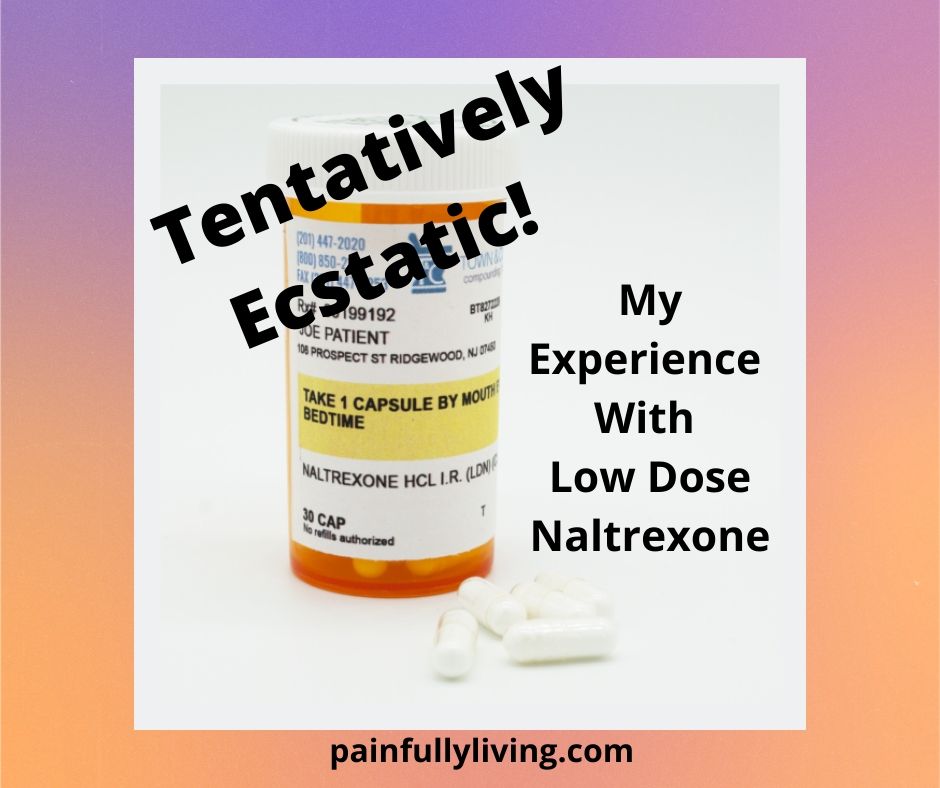
Tentatively Ecstatic! My Experience With Low Dose Naltrexone Part 1


I was in a painful flare and starting to get desperate. Although mindfulness and meditation help, I felt like I couldn't continue to push through.  I cried. Hard.  Sobbing and shaking. Which isn't great when you're already in pain.  "This is too hard!"

My husband calmly said as he caressed my hair and massaged my temples, "You can do this.  You are strong."

The next day, I messaged my general practitioner. He's been very supportive, albeit not very familiar with Fibromyalgia (as are most doctors). I decided to finally ask if he would prescribe me Low Dose Naltrexone (LDN). After reviewing my request and the link to research on the topic, he tentatively agreed to give me a month's dose, stating that the research, while promising, was small.  When I responded (via messages through MyHealth.Spectrum.org) thank you, I would like to try 2.0mg dose.  He was a bit flabbergasted. "It's only sold commercially in 50mg tablets. Do you know how to get that low of a dosage?"

This is when my online Fibromyalgia support team has been essential.  Through my research and their input, I knew more about LDN than my doctor. I first learned of LDN from Donna, on her website Fedup With Fatigue.  She gave me a bit of guidance on the dosing and titration that she followed because I knew the 4.5mg was a general ending goal, not a starting point. She also gave me a wonderful resource of knowledgeable people all finding their own way with taking LDN via the Facebook group: Low Dose Naltrexone for Chronic Illness and Infections. Brian Haviland, the administrator of the group, and several members have given me good information on how to proceed. 


Starting Dosage

My general practitioner has no experience with LDN dosing (because this is off-label for Fibromyalgia and most other issues it's being used for-more on why below).  I sent him research reports on the topic and he then wrote a 30 pill prescription for 4.5mg. Being it has to be filled at a compounding pharmacy, I had them send it via fax to a compounding pharmacy in the city about an hour away from us.  As kismet would have it, the pharmacy technician that I spoke to, had been taking LDN herself for a while to help her manage Lyme disease.  She was very positive about her results. She was the one that suggested that I go with 1/4 the dose. So, I began at 1.125mg.

How to Adjust LDN Dosage Level

Due to LDN being commercially sold at 50mg tablets and even the low dose level many get compounded not being the level the individual can handle (like mine of 4.5mg), those who are in the know have developed an ingenious way to adjust dosage level.

Here's what I've done (on guidance).  I put 4 ounces of distilled water (ml is fine, too, but I live in the USA, so...😉) into a jar like the one shown above.  I opened the 4.5mg capsule and poured the contents into the water.  I, then, stirred to dissolve it, letting it sit a bit, covered in the refrigerator before taking it the next morning.  


In the jar, at the bottom of the solution are white particles that don't dissolve.  These, I've found out, are the filler in the capsule.  I asked the compounding pharmacists what type of filler was used in my capsules.  He responded, "Avicel.  It's a filler with low allergy issues." I'll talk more about fillers in future posts in this series on LDN because this can be important.

To get the dosing amount you want, you have to do a bit of math.  With 4 oz of water added to 4.5mg of LDN, if I take 1oz of the solution, I am getting 1.125mg (4.5/4).  However, you could have 4 cups of water and drink 1 cup for the same 1.125mg.  Make sense? (Thanks, hubby/math-guy for the lesson.)


My Initial Reaction

Three days in and it became apparent that I had too high of a dose at 1.125mg.  This is definitely an individual thing, and one has to find their own path with the information given by others.  Some can start with 4.5mg and have no side-effects from the get-go.  Some, can start at 2mg and bump up every few days until they get to 4.5mg.  (I will be explaining that while 4.5mg has been the treatment level most researched; it's not the optimum level for all people.)


Feeling terrible, I stayed in bed
for 3 1/2 days straight.
Cold packs on my head and the back
of the neck helped some.


And so, I was not going to fit into the "normal reactions" group (surprise, surprise). I was so dizzy, weak, nauseated, and a contraction type of headache at my temples and forehead.  For 3 1/2 days, I was in bed.  I threw up several times (which is difficult for me to do because I had the Nissen procedure of GERD that created a knot at the top of my stomach) and didn't even want to drink water.  I was ready to give up.

Luckily, I had the FB LDN group.  They gave me encouragement and advice. I decided to press on. 


I really am appreciating
all the support and advice
I've gotten prior and during
this first couple of weeks.

One suggestion that I latched onto was to take a day off to "clear the receptors" and then, start back up on a MUCH lower dose of 0.25mg.  And this is what I did.

I still felt horrible all the next day (day 4) without taking any LDN.  The following morning (day 5), I wasn't nauseous anymore but was very weak and tired.  With the words of supports in my head and the knowledge that if I don't push through I will never know if it works for me, I took 0.25mg.  

To do this, I dissolved one 4.5mg capsule as described above, but this time, I added it to 9oz of distilled water.  I then took only 0.5oz of that solution, carefully drawing off from the top as to avoid getting any of the Avicil filler that was resting at the bottom of the glass jar.  The math for this is 4.5/9=0.5mg per ounce/2=0.25mg.  

It was a grey day outside, so I gave myself the grace to lie around one more day.  I meditated lying prone in bed and fell asleep on and off until 4pm in the afternoon. And then, it all passed.  I felt as if a switch had been turned on, I had recently watch Back to the Future and envisioned my reaction to being much like Marty Mcfly's coming back from nearly fading away into nothingness.


Much like Marty, I was not able to function,
and then, wham! I was back!

Who is This?

That night around 8pm, I got a burst of energy.  I cleaned up the kitchen which had a pile-up of dishes, folded the laundry that had been sitting in the dryer for a couple of days, and finished writing my first post in a series I'm planning to write on teachers and stress. My husband, who had been working hard all day putting up drywall, was winding down on the couch, reading.  He looked up as I was scampering around the house. Smiling, he said, "Who is this? You're feeling better, I see."  That night, I struggled to fall asleep but wasn't feeling bad about it.  I finally drifted off around 2am.  

I've come to appreciate the
utter love this guy gives even
when it means I get woken by
a wet nose every morning.


Around 6am, Scout, my tiger cat began his ritual of nuzzling my ear, then cheek, then hovering close enough to my lips that I can feel his breath on them.  My husband had already gotten up, so I was there alone for Scout to pester until I was fully awake.  This is early for me.  7:30am is my goal time for getting up and around, but Scout wasn't having any of that this morning.  And to my surprise, I woke up alert.  I was able to bound out of bed pretty quickly, feeling very little pain and stiffness that I normally have every day.

I was able to complete some blogging work, straighten up the house a bit, and when my husband asked if I wanted to go for a hike in the woods, I had the energy to say, "Yes!"  We went on a four-mile hike.  The sky was blue with white clouds and the forest world seemed as if it was awakening from the cold of winter, finally. It felt so wonderful to be outside, hiking, talking with my hubby, and having next to no pain.


Getting out into nature
is my healing place,
especially now that we're
warming up and getting
some sunshine.

I had two more AMAZING days like this.  My mood was up, my energy abundant, very little pain (until evening, but not bad-level 4). I was able to get myself ready (shower and even a bit of make-up), practice yoga and meditation, straighten up the house, practice my guitar, socialize with Zooming and a bit with the neighbor (at safe distancing), rake up our shoreline of layered wet, oak leaves, and then still have the energy to sit in the hot tub with my husband. To top things off, we had a warm-up to 55o and sun which is a commodity that's fairly rare right now in Michigan. These were three AMAZING days for sure.  


Each of these three nights, though, I struggled to get to sleep.  I didn't feel agitation or racing heart or anything, but I felt clear-headed and alert.  I ended up taking THC oil (2 drops sublingual) and with meditation, I fell asleep decently at midnight (headed to bed at 10pm) and slept until 7:00 (when Scout begins to wake me up). Each of these awesome mornings, I woke up feeling clear and energetic.  My pain was noticeably more intense and in more areas than normal (Level 5+). However, not long after taking my 1/2 oz LDN solution, it diminished to a level 2+.  I was ecstatic at how I was doing and couldn't stop telling everyone. This, I feel, might bring me back to a level I didn't think would be achievable.

The end of my raking the
shoreline day,
it was sunny
 which made me
even more joy-filled.


When researching more about why and how this works, I found an explanation that made sense for all these improvements. "The major mechanism of action of LDN involves blocking the body’s opioid/narcotic receptors for just a very few hours (rather than the all-day blockade caused by the 50mg dosage). Those are the same receptors used by the body’s endorphins. The body responds to this by greatly increasing its endorphin production, and those higher levels last all day -- far after the blockade by LDN has ended. Endorphins turn out to be the major normalizer/upregulator of one’s immune system," states David M. Gluck, MD in My Experience with Low Dose Naltrexone.


Tentatively Ecstatic

After a three-day wonderful weekend, Monday morning came with more pain and a feeling of fatigue. Taking in that I had done a decent amount physically over the weekend, I chose not to be discouraged.  Besides, I know that at 0.25mg, I'm not yet at my personal "sweet spot" dosage level. So, I took it easy: blogging work, Yin Yoga with Bernie Clark via Gaia.com. Tuesday and Wednesday of this week were pretty much the same but less fatigue and more clear-headed. 

Today, I skipped my 0.25mg does as they suggest to clear the receptors. "It makes sense to skip a day of LDN every week to keep it working effectively. Otherwise, naltrexone and its active metabolite 6-β-naltrexol will slowly build up in the system to an ineffective level," states Richard Farr, a member of the LDN Facebook group. Then, tomorrow, I'm going to up my dose to 0.5mg. I'm planning on staying at this level for one to two weeks (deciding based on how I'm doing day 8 at this level). 

Why Isn't this prescribed more readily?


If this Low Dose Naltrexone drug is so effective for Fibromyalgia (among many other issues), then why isn't it approved by the FDA and paid for by health insurance?  Why aren't doctors more learned on the subject, and why aren't they prescribing it more readily?

The answer, unfortunately, is money.  Naltrexone has been around so long that it is considered generic.  Because of this, Drug companies can't make any money off of it. Dr. Gluck goes on to explain, "Because naltrexone has been a generic drug for many years now, no large pharmaceutical company will invest any money in the large research costs needed to gain FDA approval of these special new off-label uses of the medication. No one makes any significant money from sales of LDN! Nonetheless, there have been many small clinical studies of LDN performed at outstanding medical centers, all showing it to be safe and effective. Check my website for detailed information on the research [www.ldninfo.org/ldn_trials.htm]."


And so, I'm tentatively ecstatic to think that I may be able to get back my energy, clear-thinking, and have less pain.  That I might be able to actually count on mind and body on a regular basis instead of it feeling like every moment is a  roll of the dice. 


I will be keeping you updated on my progress.  I will not gloss it over.  If it doesn't work, I'll let you know.  Have you ever heard of LDN?  If you take or have taken it, what was your experience?  I'm especially wanting to hear from those who have taken it long-term, say 5 years+. I'd love to hear from you. I'm learning as I go.


Thank you for visiting my blog today. 

I am committing to posting once a week on Fridays.  
However, as you know, my new normal means that sometimes 
I have to listen to my body and am not able to follow through 
as planned. Thank you for your understanding.


Friday, April 3, 2020

The Danger of Distraction: Turning Toward Pain to Eliminate Suffering


As we are all hunkered down at home, figuring out what to do with all our extra, unstructured time has been a hot topic.  Posts share activities to do alone, with our children, with others outside of our walls via technology tools such as Zoom (live meditation, book club, or family talk sessions), YouTube (online Tai Chi, house concerts, book readings), and Board Game Arena (where you can play board games online with people all over the world). 

I have friends posting the latest puzzle they've completed, new drinks they concocted with special COVID-19 satirical names, socks they've knitted, and latest movie marathon or binge-worthy show they have found.


While all of these things are wonderful, and I am so thankful to have so many options for how to spend my days while at home, I have come also to understand that it can be detrimental as well. I'm sure I'm not alone when I share that I've been feeling emotional pain (anxiety and sadness) along with physical pain-Fibromyalgia muscle and joint pain all over my body that flares up in roving areas throughout the day. When I experience pain, my goal is to always get rid of it.  I see it as bad and not a feeling I want around.  If I can be distracted from it, I chose that.

Distraction from Pain Doesn't Heal Pain


If you've been following my blog, you know that I've been taking an online Mindfulness-Based Stress Reduction (MBSR) meditation course through palousemindfulness.com. (To get a background for what I'm doing, check out this post Mind Over Matter: 21 Days of Meditation.) During week 5, I was introduced to a woman who has had a lifetime of severe pain (physical and mental), Vidyamala Burch, who has created a mindfulness program to live well with pain. She explains in her book Living Well With Pain and Illness, "When you bring awareness and curiosity to the actual experience of pain, often you find that it's not as bad as you feared."

The focus of my last two weeks has been to use meditation when I'm not feeling well (physical pain or emotional pain) to then TURN TOWARDS pain. I also just finished reading The Subtle Art of Not Giving a F@#!$ by Mark Mason which hammered in the same premise. "In every case, we can choose to avoid our pain or choose to engage our pain. When we avoid our pain, we suffer. When we engage our pain, we grow," states Mason in his blog post My Life Philosophy.

"We suffer for the simple reason that suffering 
is biologically useful. It is nature’s preferred agent 
for inspiring change." -Mark Manson 


During my studies this past week, I was introduced to the idea of the Felt Sense which is a concept that describes internal bodily awareness that arises from increased awareness.  Basically, it is a turning towards the sensations in our body (often difficult to describe) to bring them to consciousness.  Manson suggests, "We suffer for the simple reason that suffering is biologically useful. It is nature’s preferred agent for inspiring change."


Much like the Disney movie Wall-e shows, if we were always content with no problems or pain, we'd also become complacent. With pain and need, comes innovation and solution. I'm sure if I had not developed Fibromyalgia, for example, I would not be here writing, researching, digging into knowing more about what makes me tick. I was pretty content to ignore myself.  But my 'self' wasn't having any of that. The poem, The Felt Sense Prayer, concretely illustrates how the human mind and body work together not only to protect us but to grow us.
It's a longer read, but so worth it.

Tara Brach, Psychologist, Author, Teacher, 
reads this poem and shares how she 
came to turn towards her own pain. 

Manson contends, "Like physical pain, our psychological pain is an indication of something out of equilibrium, some limitation that has been exceeded." If we then focus into that pain, becoming aware it's there, we are then able to come back to balance.  

Burch has created a 5-Step process to turn towards our pain so that we can live FULLY. "... the only authentic and sustainable way to be fully alive is to be open to all life's moments, not just the ones I prefer," she explains.  This life is short; I want to live as fully and as authentically as possible.  My years of ignoring, blocking, and last year this time, drowning in pain, has brought about a sense of discord between my body and mind.  These past three weeks of consciously turning toward pain (emotional and physical), I am noticing a sense of ease and balance blossoming within. 


Step One: Awareness


Meditation is just taking time to focus inward. For me, I focus on the feel of my breath coming in through my nostrils, down my windpipe, and into my diaphragm like a cool, silky ribbon.  Then, at the turning point of exhaling, I follow it's warmth in reverse; inevitably, my body releases a bit more into the bed, mat, chair as I do this. Getting distracted is natural. Burch explains, "You'll probably find yourself caught up in distractions hundreds of times a day, but choosing awareness even once is a victory, no matter how fleeting that moment may be." So, I've learned not to criticize myself for having a monkey-brain, but to notice and celebrate when I realize I'm off my focus point and come back to it. 


Step Two: Turn Toward the Pain


This is the time when I pick out one thing to focus on. Maybe the aching, burning pain deep in my left thigh or the tight, weighted feeling in my chest that shows up when I'm anxious. As I continue breathing, I focus on the feeling, imagining the breath to reach right there.  I may even put my hand on the main area. And then, I work to notice the sensation, being as descriptive as possible: burning, aching, sharp, sadness, loneliness, etc.  My meditation teacher, Dave Potter, says to say "I notice that there's something in me that has the feeling......" This wording allows me not to identify myself as this difficult feeling but to acknowledge that it is there.  I notice the area, size, shape, and texture of the sensation.  Sometimes it is thin and blanket-like, resting almost overtop of me. Other times, it seems to be rounded and blobby, thick as a donut. It can be sharp and hard or dull and wooden or elastic and ropey. I notice my feelings about this sensation. At this point, I work to soften my approach to it; allowing it to be.  Treating it and myself as I would a child who was hurt, being gentle and loving.

Step Three: Seeking the Pleasant


Breathing into the difficult sensations, accepting them as they are, I begin to notice minute changes in the feelings. Then, I begin to scan my body.  Starting at my toes and slowly scanning to the top of my head, I search for a pleasant sensation. At first, I really didn't get this. I have pain all the time in nearly every part of my body. However, with practice, I've gotten better at noticing the little pleasant tingle in my earlobe, or the buttery softness of the blanket that's covering me. This is not a distraction of positivity as Burch explains, "This attitude of sensitivity, openness, and honesty to the whole of your experience, including your pain, now allows you to gently turn to the pleasant aspects of the moment that have been there all along, just outside your field of awareness. You can feel stable and whole, rather than grasping for pleasure to avoid your pain."


Step Four: Broadening Focus to Develop Equanimity


At this point, after about twenty or more minutes in the above three stages, I spread my focus to encompass my whole body (noticing the pleasant and difficult sensation is still there).  Widening out, much like you do when you zoom out in Google Maps.  Focusing then on the room I'm in, still noticing my body's sensations, then widening out to the neighborhood, town, and world.  This seemed like a hoaky part of the turn towards meditation; however, I'm beginning to understand and assimilate that this is the time I realize I'm not alone in this.  I am reminded that pain is a part of the human experience. This leads to acceptance and non-judgment of my situation (equanimity).


Step Five: Learning to Respond Rather Than Reacting


I can choose my response to whatever difficult feelings I'm experiencing.  I can choose to accept and soften into it, being loving and gentle with myself. "Rather than feeling your pain is right on top of you and you're trapped in a battle that leaves no space to choose your response, you can find ways to respond creatively to any circumstances with a soft and pliant heart," teaches Brach.
This is not magic.  It takes practice, over and over.  I'll notice, hey my throat feels tight and achy.  When that happens, taking time to Turn Towards right then, makes this a choice that gets easier and easier. And as I am finding, more effective each time. 


Vidyamala Burch explains how she's learned to manage her own pain through meditation and breathwork. (21 minutes) 


Helpful Resources:


How do you handle difficult feelings/sensations? What do you think of Vidyamal's method of turning towards pain to live more fully?


Thank you for visiting my blog today. 

I am committing to posting once a week on Fridays.  
However, as you know, my new normal means that sometimes 
I have to listen to my body and am not able to follow through as planned. 
Thank you for your understanding.

Click link Subscribe to Pain FULLY Living Weekly Posts by Email


Tuesday, July 2, 2019

Fear of the Fibro Flare


A Fibro Flare is an increase in symptoms: all over body pain,
foggy brain, fatigue, weakness, dizziness, etc.
This can last a day or two or but can continue for
days or months.
So, last Friday, I went to yoga for a wonderful SOMA Breathing Class of 90 minutes.  Joan, my yoga teacher, is a certified instructor.  There were about  5 of us.  Joan first guides us into a preparation meditation, then we did three rounds of SOMA breathing (see above explanation link), towards the end, she brings us back through a closing meditation, and finally Savasana.  First off, Joan is a poet.  Her meditation guidance is so beautiful and inspirational.  Then, the deep, slow belly breathing, I know it sounds weird, but it's calming and energizing, dreamy and clarifying.  It really was profound for me this time, more so than the several times before.

I felt so strong and confident.  I felt I could do anything.  This is a feeling that I haven't had for at least three years, and this past year has been so far from this feeling that I thought I'd never have it again. I came to the decision that I wanted to buy a local building/business.  I could just see it being the perfect place for the meadery that my son would like to one day own and Kelley and I are interested in being a part of. I went home and talked to Andrew and Kelley about it, ignoring to the most part Kelley's practical yet deflating concerns.


Then, I went to the doctor's for my 11 am appointment to get the Shingrix shot (2nd dose).  I knew to expect the "punched in the arm" sensation that I had with the first dose.  I do wish the nurse, however, had warned me that there could be more to it than that.

Still feeling really strong and positive, I went to do some volunteer work that involves organizing a HUGE library of literacy resources. (Right up my alley!)  After a few hours of moving books around in a fairly warm attic, I went home to get cleaned up and go to look at the building.

By 3:00 pm, I was starting to feel really body tired and to develop a headache along with my left arm hurting like I'd let someone punch me as hard as they could to show that I could take it.  Our meeting at the building was good.  Many questions answered.  More and more I could feel, though, that I was really starting to disintegrate. By the time we got home after stopping for our favorite ice cream, 5pm, I had to go to bed, my entire body now felt like I'd been pummeled.

Now, the panic started setting in.  I had been feeling soooo good.  Yes, a bit of pain, but it wasn't stopping me from doing what I wanted to do. Crying, I told Kelley that I couldn't be counted on for commitments like the business.  If a vaccine was going to through my body into an all-over flair of this degree (probably my first 7/10 on the Medical Pain Scale), I realized that I couldn't count on this body and mind to allow me to do whatever I wanted with my life.


 I ended up being up all night.  After going to the couch to allow my husband to sleep, I tucked myself into supported savasana with my extra soft, fluffy blankets (3) and my comfort pillows (3). That's when the unstoppable shivering and feeling cold to the bone started along with feeling nauseous. I tried my go tos: going to the couch to allow my husband to sleep, breathing, heating pad, massage, stretching, meditation, Bayer: Back and Body (still on the 30mg of Cymbalta before bed), drinking water, and bundling up.  But, nothing worked until about 4 in the morning, the shivers and fever passed. I was finally able to fall asleep.

In the morning, as the sun rose, I awoke.  The pain was still there all over but much less severe.  I could get up, get my morning meds, and research the Shingrix shot.  And here's what I found:  Some people felt tired, had muscle pain, a headache, shivering, fever, stomach pain, or nausea. About 1 out of 6 people who got Shingrix experienced side effects that prevented them from doing regular activities.  Symptoms went away on their own in about 2 to 3 days. Side effects were more common in younger people.

A sense of relief came over me almost washing away the pain completely. It was just side effects!  Not my fibro-brain reacting to the shot and shoulder-site pain, turning it into an all-over body alarm. It wasn't a Fibro Flare!  My body bounced back to normal (except the left shoulder pain that lasted until Monday morning).

I know flare-ups will come.  But, I'm mostly confident I can manage them.  I also feel like little things like a shot won't cause my body to go into complete alarm mode.  I don't want to live my life out of fear of a flare. I want to do what I want to do when I want to do it (within the frame of self-care and listening inward).  This scare, really helped me to see that I can't live as if trying to stay away from triggers.  That's just too limiting and will mean that fear will rule my decisions.  I choose courage (with the help of others) and when the flare is triggered, I chose to manage the symptoms (with the help of others), knowing I have done this before and will make it through.


PS-For a variety of reasons, we have decided not to buy the building.  One of those reasons, however, is not because I can't be counted on.

PSS-I do totally support getting the Shingrix vaccine.  A weekend of inconvenience is way better than getting Shingles!

PSSS-The management strategies I have learned will be shared in future posts.


How do you handle the fear of a flare?  Can you get past the fear?  What makes you feel strong?


Thank you for visiting my blog today. 

I am committing to posting once a week on Fridays.  
However, as you know, my new normal means that sometimes 
I have to listen to my body and am not able to follow through as planned. 
Thank you for your understanding.

Click link Subscribe to Pain FULLY Living Weekly Posts by Email